Design Assurance Levels and AI-Generated Code Under DO-178C
DO-178C objectives stay the same when an AI coding agent writes the code. Which ones need new evidence, and where the agent sits in tool qualification.
In short
A design assurance level (development assurance level in ARP4754A and the FAA's guidance; software level in DO-178C) is set by the worst failure condition the software can cause or contribute to, from Level A, catastrophic, to Level E, no safety effect. The level fixes how many objectives the software must meet and how many of them must be met with independence. The objectives are the same whether a person or an AI coding agent writes the code, and the agent bears on the evidence behind a handful of them: that the source code complies with and traces to its low-level requirements, that the tests were derived by someone other than the code's author where independence is required, and that structural coverage was reached by the tests. A tool whose output becomes part of the airborne software falls under tool qualification criteria 1. We found no public record of a language-model tool qualified under DO-330, and a project that takes no credit from the tool verifies its output as if it had been written by hand. EASA's 2025 proposal on AI trustworthiness, not yet adopted, would assign assurance levels to AI development tools and allocates none at the most severe hazard classes.
What a design assurance level is
The level comes from the safety assessment of the aircraft. The FAA's advisory circular on airborne software states that "The system safety process assigns the minimum development assurance level based on the severity classifications of failure conditions for a given function" (FAA, AC 20-115D, Airborne Software Development Assurance Using EUROCAE ED-12( ) and RTCA DO-178( ), 2017, paragraph 9.b(2)). For transport airplanes the top of the severity scale is "A failure condition that would result in multiple fatalities, usually with the loss of the airplane", and "The rigor of development assurance should be determined by the severity of potential effects on the airplane in case of system malfunctions or loss of functions" (FAA, AC 25.1309-1B, 2024, sections 3.1.5 and 5.3.4.2).
DO-178C itself is published by RTCA and, as ED-12C, by EUROCAE, and its text is available for purchase. Public descriptions give its structure. Level A corresponds to a catastrophic failure condition, B to hazardous, C to major, D to minor and E to no safety effect. A 2023 paper from the universities of Porto and Coimbra gives the number of objectives as 71 at Level A, 69 at B, 62 at C and 26 at D, of which 43, 41, 34 and 9 are verification objectives, and notes that Level E is "the only level excused from requiring verification activities" (Ribeiro, Silva and Aguiar, Beyond Tradition: Evaluating Agile Feasibility in DO-178C, arXiv 2311.04344, Table 2). Vendor summaries disagree, by three at every level, on how many objectives must be satisfied with independence, so we leave those counts to the standard.
The FAA's instruction is to meet all of them: "You should satisfy all of the objectives associated with the software level assigned to the software and develop all of the associated life cycle data demonstrating satisfaction of the applicable objectives, as listed in the ED-12C/DO-178C Annex A tables" (AC 20-115D, paragraph 6.a). The ten Annex A tables run from planning and development through the verification of requirements, design, code, integration and of verification itself, to configuration management, quality assurance and certification liaison.
What does not change
The objectives describe properties of the software and its life cycle data. In the public listings, the coding objectives read "Source code is developed", "Source Code complies with low-level requirements" and "Source Code conforms to standards", with no reference to the author (AdaCore, AdaCore Technologies for Airborne Software, summary of contributions to DO-178C objectives). Code written by an agent is held to the same objectives at the same level as code written by a person. The software level is unchanged too, since it follows from the failure condition.
The FAA's roadmap for AI safety assurance treats AI the same way. Among its principles is "Treat AI as a tool, not a human", with "clear responsibility assignment" (FAA, Roadmap for Artificial Intelligence Safety Assurance, version I, 2024). A tool in DO-178C has an established place: section 12.2 and DO-330, which the FAA describes as containing "its own complete set of objectives, activities, and life cycle data for tool qualification" (AC 20-115D, paragraph 10).
The objectives an agent-written change touches
The agent's output is source code, sometimes with low-level requirements or tests beside it. The table marks the Annex A objectives whose evidence depends on how that output was produced and checked. Objective wording follows AdaCore's public listing; the right-hand column is ours.
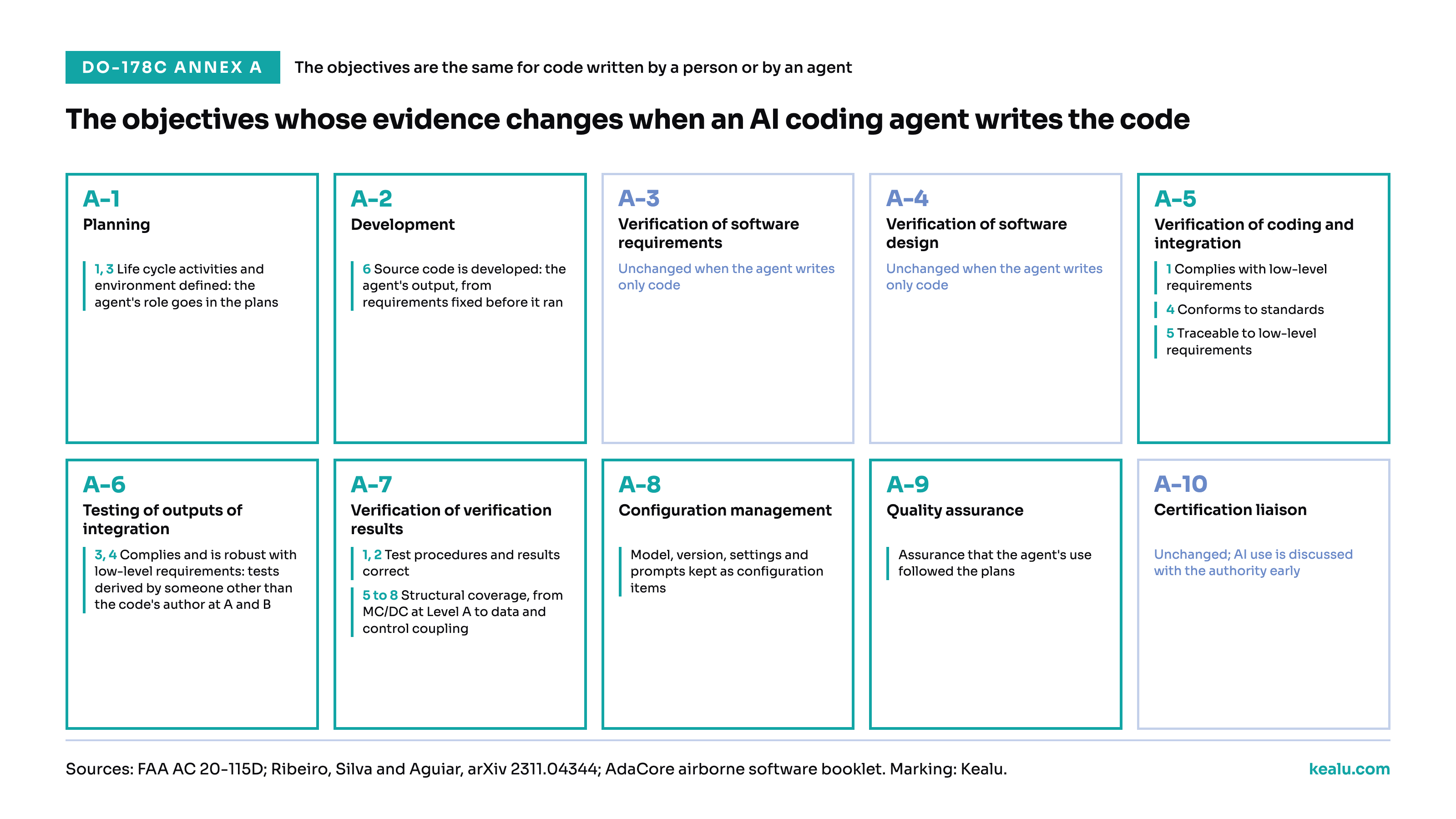
| Annex A objective (public wording) | Why it is agent-affected | Evidence an agent-written change carries |
|---|---|---|
| A-2.6 Source code is developed | The agent produces the code | The low-level requirements and design it worked from, fixed before it ran, and the change request it answered |
| A-5.1 Source Code complies with low-level requirements | The code reflects the agent's own reading of the requirements, which nobody else has checked | A review record of the code against the requirements by someone who did not write the prompt or the code |
| A-5.4 Source Code conforms to standards | In one study, no model tested wrote code that met the coding standard on the first prompt | A conformance check against the project's coding standard by a tool or reviewer independent of the agent |
| A-5.5 Source Code is traceable to low-level requirements | An agent can write code beyond what the requirement asks | A trace from every changed unit to a requirement, recorded at commit time, and a review of untraced code |
| A-6.3 and A-6.4 Executable Object Code complies with and is robust with low-level requirements | Tests the agent wrote share its reading of the requirements | Tests derived by someone other than the code's author where independence is required, and the derivation recorded |
| A-7.1 and A-7.2 Test procedures and results are correct | The agent may write both the code and its tests | A review of test procedures and results that does not rely on the agent |
| A-7.5 to A-7.8 Test coverage of software structure is achieved, from modified condition / decision coverage to data and control coupling | Coverage gaps reveal code the requirements did not call for | MC/DC at Level A, decision coverage at B, statement coverage at C, and data and control coupling, measured on the agent's code by a coverage tool |
| A-8 Configuration management and A-9 Quality assurance | The agent's model, version, settings and prompts shape the output | The agent recorded as a configuration item, and assurance that its use followed the plans |
Three of the rows rest on public evidence about the tools. On coding standards, a 2025 study that asked five widely used language models to write code to the MISRA C++ guidelines found that "none of the evaluated LLMs generated MISRA-compliant code despite clear prompts", while all of them could correct individual violations once told to (Umer, IEEE Access, 2025, arXiv 2506.23535). A single study of chat assistants prompted without a checker in the loop shows the risk, and the conformance check is what catches it. On tests, AdaCore's guidance notes that "Independence is required between code development and test case derivation, to satisfy the independence criteria of objectives A6-3 and 4 for software level A and B" (AdaCore, AdaCore Technologies for Airborne Software, analysis chapter), so an agent that writes the code at those levels cannot also be the source of the tests that verify it. On coverage, the criterion rises with the level, MC/DC at Level A, decision coverage at B and statement coverage at C, as public descriptions of the standard set out, and a gap in structural coverage is one way code that no requirement asked for comes to light.
The plans come first. Table A-1 asks that "The activities of the software life cycle processes are defined" and that the "Software life cycle environment is selected and defined", so an agent's role in development or verification belongs in the plans, where the authority sees it. The FAA's roadmap anticipated this: a planned policy statement would ask applicants who use AI "in their systems, or in the development of documents" to "disclose that use and discuss a certification path with the FAA early in the development phase".
Where the agent sits in tool qualification
DO-178C sorts tools by what they can do to the software. The public descriptions of section 12.2.2 give three criteria, the first "A tool whose output is part of the resulting software and thus could insert an error" (Ansys, SCADE aeronautics handbook, quoting DO-178C section 12.2.2). The second covers a verification tool whose output is used to eliminate or reduce other processes, and the third a tool that "could fail to detect an error". DO-330 places code generators in the first: "Criteria 1 is applied to the tools that automatically produce a part of the outputs of one of the software development processes, whatever the input and output format are", source code included.
An agent that writes code is a criteria 1 tool in that sense, and one that reviews code or writes tests falls under criteria 2 or 3, depending on what credit is taken from its output. The FAA's correlation table pairs a criteria 1 tool with TQL-1 at Level A, TQL-2 at B, TQL-3 at C and TQL-4 at D, and a criteria 3 tool with TQL-5 at every level (AC 20-115D, Table 2, a correlation for tools first qualified under DO-178B). Qualification "is the process necessary to obtain certification credit for a software tool within the context of a specific airborne system" (FAA, Order 8110.49A, 2018), and it assumes a tool with defined operational requirements whose behavior can be verified against them. We found no public qualification of a language-model coding tool under DO-330 at any level.
Without qualification, the tool earns no credit. Ansys's handbook paraphrases the trigger in DO-178C: "Qualification of a tool is needed when processes required by DO-178C are eliminated, reduced or automated by the use of a software tool without its output being verified." A project that verifies the output takes no credit from the tool and needs no qualification, and that is the route a project can plan on without a qualified tool. Every marked row in the table has to be met by evidence that does not rest on the agent.
What the regulators have said
The FAA's roadmap lists software development as a research priority: "A second priority is the potential use of AI to improve the fidelity and completeness of software development, software testing, and requirements traceability." It adds that language models may carry out some of this work with more assurance than manual practice, but that "it is possible for the LLM to generate spurious or hallucinatory material or fail to comply with some criteria". The roadmap's table of planned work includes a policy memo on considerations for AI and machine learning "Used in the Development of Airborne Systems and Equipment", marked as a 2024 draft. We found no published version of that memo.
EASA has gone further on paper. Its Notice of Proposed Amendment 2025-07 on AI trustworthiness, whose comment period was extended to 10 March 2026 and which has not been adopted, would set assurance and tool qualification levels for systems "developed using AI technology". The proposal covers AI-based systems it classes as high-risk and, its explanatory note says, is "initially targeted at supervised and unsupervised machine learning". Its Table 4 allocates levels to AI-based development tools by hazard contribution on its own scale, from H1, fatalities, to H5, no impact: AL3/TQL3 at H3, AL4/TQL4 at H4 and AL6 at H5. H1 is excluded from the whole proposal, and the table allocates no development tool at H2 (EASA, NPA 2025-07 (B), DS.AI, AMC1 AI.130). The proposal excludes from its scope "AI-based verification tools involved in the verification of AI-generated artefacts, unless all outputs of the AI-based verification tool are independently verified by a human user", and the explanatory note gives the reason: "to ensure human oversight at development time when using generative AI techniques by avoiding the double development and verification with AI tools". The same note says that "generative AI tools and general-purpose models are not yet fully covered". The proposal does not state how its H classes and levels map to DO-178C software levels.
The joint SAE and EUROCAE guidance on machine learning in airborne systems, ARP6983 and ED-324, addresses learned components inside the product and carries a target publication date of 31 December 2026 (EUROCAE WG-114). On AI-generated assurance material, a 2025 NASA technical memorandum recommends that "regulatory authorities and developers approach LLM-based argument technology as experimental" (Graydon and Lehman, NASA/TM-20250001849).
What changes in practice
The code an agent writes sits on the left side of the V, and DO-178C puts most of its objectives on the right. At Level A, 43 of the 71 objectives are verification objectives in the Porto and Coimbra count, and that is where an agent-written change needs evidence produced by means other than the agent. The change starts from approved low-level requirements, carries a trace to them from each unit it touches, and is reviewed against them by an engineer who did not write the prompt. Its tests come from the requirements, written by someone other than the code's author where the level requires independence, and its structural coverage is measured on the code it produced. The agent's model, version, settings and prompts are configuration items, so the conditions under which the change was produced can be shown when the authority asks. Our IV&V article places a check run by another model close to the producer on a range that ends at a separate organization, and EASA's exclusion of AI verifying AI points the same way.
The standard has a second route for code a project did not develop under its plans, through previously developed software and service history, and the FAA's December 2025 status report to RTCA's program management committee lists DO-395, on integrating COTS, open source and service history into software, among the RTCA documents in work (RTCA, PMC report, December 2025). Neither route gives credit for how the code was produced. The same holds for the functional safety standards, as our article on safety integrity levels sets out for IEC 61508, and the assurance case is where the evidence for each marked objective is kept for the reviewer.
Where Kealu Vector fits
The Agentic Engineering Assurance Layer is the proposed category for the layer that governs how agentic engineering work is performed and evidenced, so that humans can trust and accept the resulting work. Our white paper AI Has Moved the Bottleneck sets out the problem it answers, and the questions raised here hold whatever tools a team uses to answer them. Kealu Vector, currently designated Vector Assurance Assist, is our early-access implementation of that category. Any tool that records or produces verification evidence in a DO-178C project, Kealu Vector included, is assessed under the tool qualification criteria like any other.
FAQ
What is a design assurance level?
A design assurance level, called the software level in DO-178C, is a rating from A to E assigned to airborne software by the system safety assessment, according to the most severe failure condition the software can cause or contribute to. Level A corresponds to catastrophic failure conditions and Level E to no safety effect. The level sets how many DO-178C objectives apply, how many must be satisfied with independence and how much structural coverage the tests must reach.
How many objectives does DO-178C have at each level?
Public summaries of DO-178C give 71 objectives at Level A, 69 at Level B, 62 at Level C and 26 at Level D, with none at Level E. Of those, 43, 41, 34 and 9 are verification objectives. The standard also marks which objectives must be satisfied with independence, and public summaries disagree on that count, so the standard itself is the reference.
Can AI-generated code be used in DO-178C software?
DO-178C does not restrict how source code is produced, so code written by an AI coding agent is held to the same objectives as any other code at its level. The agent is a tool whose output becomes part of the airborne software, tool qualification criteria 1, and a project that takes no credit from it verifies its output as if written by hand: review against low-level requirements, traceability, independent tests where required and structural coverage. The FAA's roadmap plans a policy asking applicants to disclose AI use and discuss it early.
Does an AI coding tool need DO-330 qualification?
Only if the project takes certification credit from the tool. A tool whose output is part of the airborne software would need TQL-1 at Level A down to TQL-4 at Level D to earn credit, and the qualification assumes defined operational requirements the tool can be verified against. Projects that take no credit verify the tool's output instead, and we found no public record of a language-model coding tool qualified under DO-330. A review or test-writing agent whose output is used to reduce verification falls under the other criteria.
What has EASA proposed for AI development tools?
EASA's NPA 2025-07 on AI trustworthiness, not yet adopted, would set assurance and tool qualification levels for AI-based development and verification tools by the tool's hazard contribution, on the proposal's own scale. It allocates no development tool at the two most severe hazard classes, excludes AI tools that verify AI-generated artifacts unless a human independently verifies all their outputs, and notes that generative AI tools are not yet fully covered. Comments closed in March 2026.
On Google
Add Kealu as a preferred source: our articles get highlighted in Top Stories, AI Mode and AI Overviews.
Talk to our team.
Questions about this article, or about using Kealu Vector in your organization? Send us a message.
Talk to our team.