Automotive SPICE and ISO 26262 Software When Agents Write the Code
Automotive SPICE leaves tools to the team; ISO 26262 asks how an AI coding agent's errors get caught. The evidence an agent-made change carries.
In short
Automotive SPICE® assesses what a software process achieves and leaves the choice of tools to the team, so an AI coding agent adds no process of its own. Automotive SPICE® is a registered trademark of the Verband der Automobilindustrie e.V. (VDA). The draft third edition of the VDA's Automotive SPICE guidelines calls the use of an AI engineering tool "a how-level decision", asks the assessed organization to handle its risks "with clear criteria", and gives prompts, models and settings as examples of configuration items an assessor should look for. Under ISO 26262, on our reading, the agent is a software tool whose output reaches the product, and since no qualification method fits a language model, its tool confidence level rests on how reliably later verification detects its errors. What an assessor can check is the traceability around each change, the verification the agent did not write, and the configuration record of the agent itself.
What Automotive SPICE assesses
Automotive SPICE is the process assessment and reference model the German automotive industry association maintains through its quality management center, VDA QMC. Version 4.1, released on 24 August 2026, replaced version 4.0 of November 2023 (Automotive SPICE PAM 4.1, free download from the VDA). The model has 32 processes "divided into 3 categories and 11 groups", each rated on a capability scale from 0, incomplete, to 5, innovating. The rating is per process: "A consolidated level for a project or a company does not exist" (VDA QMC, Automotive SPICE).
Each process of the software engineering group, SWE.1 to SWE.6, carries a base practice with the same title, "Ensure consistency and establish bidirectional traceability." The note attached to it warns that the existence of links "does not necessarily mean that the information is consistent."
Three passages decide how the model treats tools. The first is about evidence: "All such evidence comes either from the examination of work products" related to the processes assessed, "or from statements made by the performers and managers of the processes." The second leaves the choice of tools to the organization: templates, proceedings and tooling are "left to the HOW level." The third brings the tool back as a resource: at capability level 2, GP 2.1.4 asks that "The individuals performing and managing the process are being qualified to execute their responsibilities", and that the other resources needed for the process are identified and made available; that is where an assessor at that level places an agent. The base practice for writing code, SWE.3.BP3, reads "Develop and document the software units consistent with the detailed design, and according to the coding principles", and nothing in it asks who or what does the writing.
What the VDA's guidelines say about AI assistance
The VDA's guidelines hold the rating rules assessors apply. Their third edition was published online in March 2026 as a yellow volume, the draft stage open for comment before the final print, with a section titled "AI assistance in development" (VDA, Automotive SPICE Guidelines, 3rd revised edition, March 2026 yellow volume, section 2.5.5). The model "defines what a process shall consider", and so "there is no limitation or recommendation regarding tool usage" by Automotive SPICE; the use of an AI engineering tool to create or update work products "is a how-level decision."
Its worked example is an interview on SWE.3. A developer explains that an AI tool generates the source code, after which "the developer reviews the results and corrects them if necessary". The assessor spot-checks the base practice for developing units, and if there are no deviations the draft sees no negative impact on PA 1.1 of SWE.3, the process performance attribute; the level 2 attributes and the support processes are rated separately. The same section explains why the review matters: with current AI tools, "less accurate and sometimes even unusable results are produced just as often as good ones." The organization must "ensure with clear criteria that risks from AI engineering tools will be adequately handled", and the method is its own choice, "whether through manual review, test driven development, or any other approach".
The section lists what assessors should check in configuration management, quality assurance and work product management. Three of its four examples are "defining new configuration items, e.g., prompts used to generate source code", the "approval of the usage of specific AI tools", and the "version control of AI tools, models, and settings, because their behavior changes over time"; the fourth puts the work products used for AI assistance under quality control. The quotations are from the yellow volume; the final edition, in print since July 2026, may word this section differently.
The same draft has rules for code generated from models. There, "Unit verification performed at the model level shall provide evidence" of consistency with the design and the requirements, and when the generator is qualified and the code untouched after generation, SWE.4.BP3 is not downrated for the absence of static verification and unit tests on the code. A qualified tool chain means "there is evidence that the generated code is correct and consistent with the model." The comparison with AI-generated code is ours. A prompt is not a verified model, and agent code is often edited after generation, as in the draft's own example, so it falls under the rule that asks for static verification and unit tests.
Where ISO 26262 meets the agent
ISO 26262 covers functional safety of electrical and electronic systems in series production road vehicles. Part 6 sets the requirements at the software level, from the software safety requirements through unit design and implementation and "software unit verification" to integration and testing of the embedded software, and part 8 lists among the supporting processes "confidence in the use of software tools" (ISO 26262-6:2018; ISO 26262-8:2018).
Clause 11 of part 8 is paywalled; public vendor material describes how it works (Synopsys, Understanding How to Assess Tool Confidence Levels for ISO 26262, 2017, written against the 2011 edition; Validas, Tool Confidence Level). Tool impact asks whether a malfunction "can introduce or fail to detect errors in safety related element", in Synopsys's summary, and "If there is an impact, it is rated as TI2", in Validas's. Tool error detection rates the confidence that there are "measures to prevent and/or detect tool malfunctions", from TD1, high, to TD3, low. A tool with impact is TCL1 with high detection, TCL2 with medium and TCL3 with low, and TCL2 and TCL3 call for qualification by methods graded by ASIL: increased confidence from use, evaluation of the tool development process, validation of the software tool, and development in accordance with a safety standard.
By that test, an agent that writes code for a safety-related item has impact, and so does one that writes tests or reviews code, through the second half of the definition. Synopsys stresses classifying a tool "accurately for your specific situation and use case", with its version, configuration and environment documented. Writing units, writing tests, refactoring and reviewing are separate use cases for the same agent, and a change of model or settings reopens the evaluation. The higher-level methods assume a behavioral specification and a controlled version. An agent can be pinned to a model version, but no specification of its output exists to validate against, its output varies between runs on the same prompt, and confidence from use needs an unchanged specification and a record of malfunctions in comparable use. Our article on functional safety and safety integrity levels sets out why the same route is closed under IEC 61508.
With qualification out of reach, the classification turns on detection. exida, which assesses tools for qualification, notes that "ISO 26262 requires no qualification methods (e.g., increased confidence from use, validation/testing) at TCL1", and in its next sentence recommends qualification for all software tools anyway (exida, ISO 26262 tool qualification report for its OEMx tool suite, revised 2025). Validas makes the same point from the user's side: the idea that TCL1 is a "free pass" is "a common misconception", because then the safety of the system "depends on the user's ability to catch every potential error the tool might make".
For an agent, a TCL1 classification is a claim about detecting each error type it can introduce: a unit that departs from the design, a coding guideline violated, an interface changed outside the assigned scope, a file edited outside the change request, third-party code brought in. Each is paired with the measure that catches it, from design review and static analysis to tests with their coverage and a scope check on the diff, performed by means the agent did not author. A team can credit only the measures its process performs at the item's ASIL, so the same agent can reach TCL1 in one project and miss it in another. The classification belongs to the team, in Synopsys's words: "The user of the software tool is responsible for the TCL value assessment", and "Any user-created scripts are also part of the tool chain and its TCL assessment", which on our reading brings the prompts, rule files and agent settings into it. The same paper notes that the results are confirmed with a level of independence that "depends on the ASIL".
The evidence carried alongside an agent-made change
The table maps the processes to what an agent-made change carries. SUP.10 is our addition; the criteria for AI-tool risks would sit in MAN.5, risk management. The middle column paraphrases PAM 4.1; the right column is ours and lists work products, which an assessor maps to the PAM's information items.
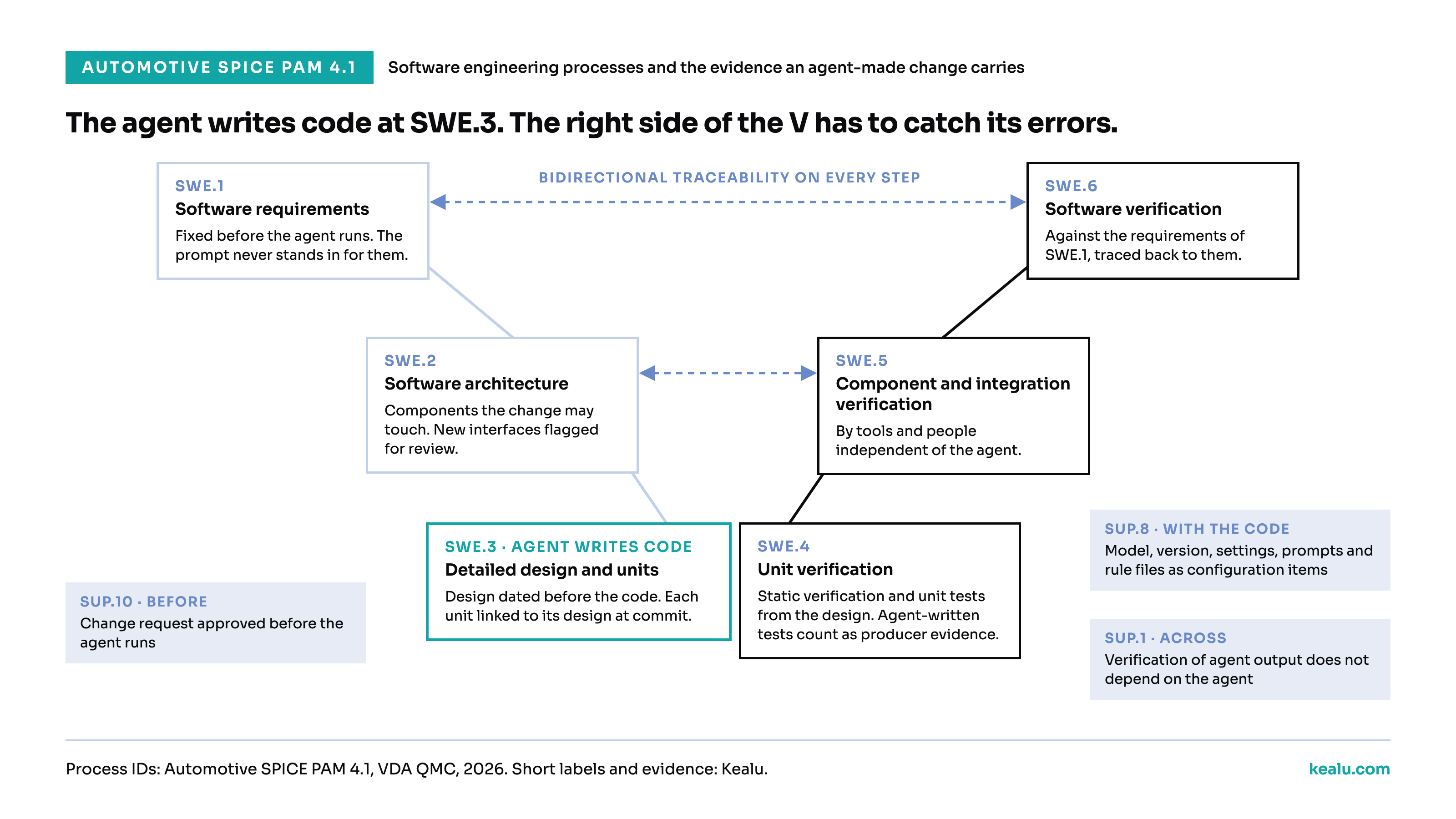
| Process (PAM 4.1) | What the base practices ask | What an agent-made change carries |
|---|---|---|
| SUP.10 Change Request Management | Change requests recorded, analyzed, approved before implementation, traced to the affected work products, and confirmed before closure | The approved change request the agent worked from, its assigned scope and the work products it touched |
| SWE.1 Software Requirements Analysis | Software requirements specified, analyzed, and traced both ways to system requirements and architecture | The requirements the change answers to, fixed before the agent runs; the prompt never stands in for them |
| SWE.2 Software Architectural Design | Static and dynamic aspects of the architecture specified, analyzed and traced to the software requirements | Components the change may touch; any interface it added or altered, flagged for architectural review |
| SWE.3 Software Detailed Design and Unit Construction | Detailed design specified, units developed consistent with it and with the coding principles, units traced to the design | A detailed design dated before the code; the coding guideline the unit was checked against; the link from each changed unit to its design element, recorded at commit time |
| SWE.4 Software Unit Verification | Verification measures specified, selected with regression criteria, units verified, results traced to the measures | Static verification and unit tests from the design, the regression set for the change, results kept; agent-written tests recorded as its output, uncredited for detecting its own errors |
| SWE.5 Software Component Verification and Integration Verification | Software elements integrated and verified against architecture and detailed design | Integration verification by tools and people independent of the agent; third-party code it brought in treated as a pre-existing component, qualified before integration |
| SWE.6 Software Verification | The integrated software verified against the software requirements | Requirement-based verification of the integrated result, traced to SWE.1 |
| SUP.8 Configuration Management | Configuration items identified, modifications controlled, baselines established | The agent's model, version, settings, prompts and rule files, baselined with the code as configuration items |
| SUP.1 Quality Assurance | Quality assurance performed independently and objectively, with no self-monitoring | A check that only approved AI tools were used and that verification of agent output did not depend on the agent |
The first row comes before the agent runs. SUP.10 has a base practice titled "Approve the change requests before implementation", and another that closes the loop: "The implementation of the change requests is confirmed before closure by relevant stakeholders." The SUP.8 row is the one the draft guidelines spell out, and the reason is in their own text, "because their behavior changes over time"; a model that drifts cannot be reconstructed from the code alone. The SUP.1 row rests on the first quality assurance practice, "Ensure that quality assurance is performed independently and objectively without conflicts of interest", which the PAM glosses as "no self-monitoring".
The PAM's annex on information items describes consistency evidence as information that is "semantically coherent along relevant artifacts", and version 4.1 lists among the examples "notes in Git commits comments". A commit is the natural place to record the change request, the design element, the model version and the pending verification, as the change is made. In item 10-52, the process resource and infrastructure description, version 4.1 also adds "Evidence for tool qualification if relevant, for example within safety critical usage."
Where traceability is already harder
A study of the testing processes, from "a sample of 13 Automotive SPICE assessments performed by the authors" covering 23 projects between 2018 and 2020 under version 3.1, found the practices for traceability and consistency "significantly weaker for SWE.4, SWE.5 processes and also for SYS.4" than for software and system verification against requirements (Falcini and Lami, ICST 2021, author postprint). In SWE.5 and SYS.4 the links run from the architecture to integration tests, and in SWE.4 from the detailed design to unit tests. The authors explain the weakness by the difficulty of linking architectural elements to tests, harder than linking a requirement to a test, and point to "a limited use of equivalent supporting tools" for it. They also state that their outcomes "have not a statistical validity".
These processes sit on the right side of the V, where an agent's errors have to be caught, and agents raise the number of changes reaching them; as our pillar on agentic engineering argues, the cost moves from writing a change to accepting it. The review checklist for agent-written changes gives the per-change questions for that step, and the assurance case is where their answers are kept for the assessor.
AI in the vehicle and AI in the toolchain
The automotive standards that name AI address it inside the product. Automotive SPICE has had a machine learning engineering group, MLE.1 to MLE.4, since version 4.0. ISO/PAS 8800:2024, Road vehicles, safety and artificial intelligence, addresses "AI elements within the vehicle" and states: "This document does not provide specific guidelines for software tools that use AI methods" (ISO/PAS 8800:2024). The third edition of ISO 26262 is at the draft international standard stage, with parts 6 and 8 among those in enquiry with ISO members (ISO/DIS 26262-8), and neither of their published abstracts mentions AI used to develop the software. Among the texts readable without purchase, the yellow volume quoted above is the most specific we found on AI as a development aid in automotive assessment.
Where Kealu Vector fits
The Agentic Engineering Assurance Layer is the proposed category for the layer that governs how agentic engineering work is performed and evidenced, so that humans can trust and accept the resulting work. Our white paper AI Has Moved the Bottleneck sets out the problem it answers, and the questions raised here hold whatever tools a team uses to answer them. Kealu Vector, currently designated Vector Assurance Assist, is our early-access implementation of that category. Any tool that records or produces verification evidence in an ISO 26262 project, Kealu Vector included, is classified under part 8 like any other.
FAQ
What is Automotive SPICE (ASPICE)?
Automotive SPICE is a process assessment and reference model maintained by VDA QMC, the quality management center of the German automotive industry association. It defines what engineering, support and management processes have to achieve, and assessors rate each process on a capability scale from 0 to 5. Version 4.1, released in August 2026, is current, and it leaves methods and tools to the organization.
Does Automotive SPICE allow AI-generated code?
Automotive SPICE places no limit on tools, and the draft third edition of the VDA guidelines calls using an AI engineering tool a how-level decision. The base practices still apply to the result, from design consistency to traceability and verification. The organization must handle AI-tool risks with clear criteria, and the draft gives prompts, tool approval and model versions as examples for assessors.
Is an AI coding agent a software tool under ISO 26262?
In our reading, yes, when it is used to develop a safety-related item or element. Part 8 requires confidence in the use of software tools, and a tool whose malfunction can introduce an error into the product, or fail to detect one, has tool impact, TI2 in the public descriptions of the clause. The higher-level qualification methods assume a behavioral specification, which a language-model agent lacks even when its model version is pinned, so the confidence comes from verification of its output by means it did not author.
What evidence will an assessor want for agent-written code in an ASPICE project?
An approved change request before the agent runs; requirements and a detailed design dated before the code; traceability in both directions from each changed unit, recorded at commit time; static verification and unit tests from the design, with the regression set for the change; the agent's model, version, settings and prompts under configuration management; and a record that verification did not depend on the agent.
Does ISO/PAS 8800 cover AI coding tools?
No. ISO/PAS 8800:2024 addresses AI elements within the vehicle and their risks to vehicle safety, with a focus on machine learning, and its abstract states that it "does not provide specific guidelines for software tools that use AI methods." AI used to write or check the software falls under the tool confidence rules of ISO 26262 part 8 and, for the process, under the organization's own criteria in Automotive SPICE.
On Google
Add Kealu as a preferred source: our articles get highlighted in Top Stories, AI Mode and AI Overviews.
Talk to our team.
Questions about this article, or about using Kealu Vector in your organization? Send us a message.
Talk to our team.